Engineering guide
A PLC trigger is not proof that the data was saved.
A machine can request a database operation and still have no reliable evidence that the operation completed. That gap becomes important when the next product depends on the result.
Separate the request from the result
Consider an end-of-line test station. The PLC collects the unit serial number and test values, then raises a trigger. Middleware reads those values, calls the database and writes a result back to the PLC. Each phase can fail independently.
If the database write fails, the PLC needs a result it can use to hold, retry or notify an operator. If the database operation succeeds but the acknowledgement write fails, repeating the transaction may create duplicates unless the database operation has been designed to recognize the prior attempt.
Define the handshake before implementation
- Transaction identity: identify the unit and operation, and use a stable transaction key where duplicate detection is needed.
- Completion states: distinguish pending, successful, unsuccessful and timed-out outcomes. Define which states may allow the machine to continue.
- Timeout behavior: decide what the PLC does when the middleware or database does not respond within the expected time.
- Retry safety: agree on idempotency, database constraints and what happens after a lost acknowledgement.
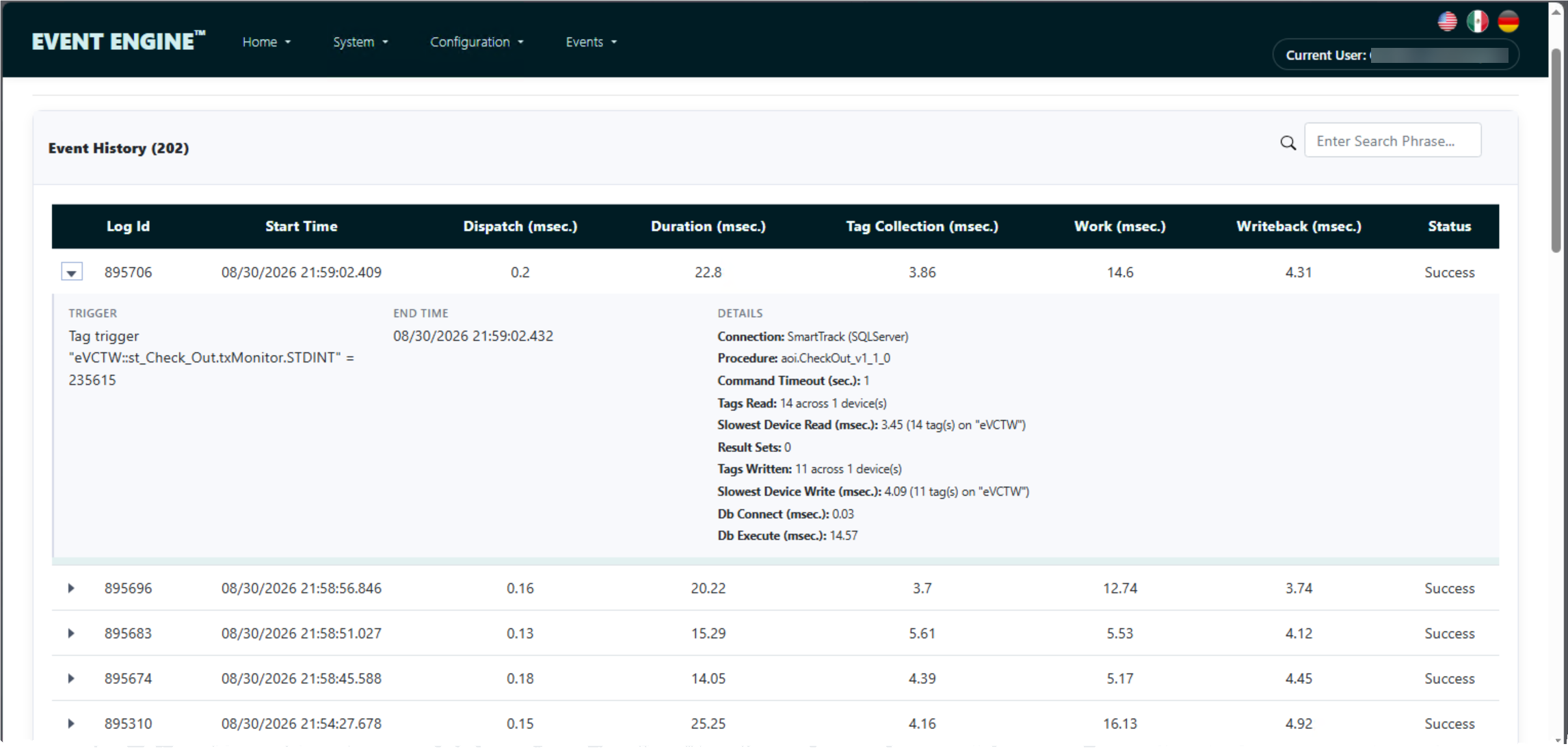
- Diagnostics: record enough context to distinguish controller communication, database work and result write-back.
A simple test sequence
- Normal cycleVerify inputs, database result and PLC response.
- Database unavailableConfirm the controller does not treat the trigger as success.
- Lost write-backVerify retry and duplicate-handling logic under a real failure.
Where Event Engine® helps
Event Engine® collects configured controller values, executes supported database operations and returns outputs and completion status. Execution details split the phases so an engineer can see where the time went or where a failure occurred.
It provides visibility and an integration mechanism. It does not eliminate the need to design the PLC sequence, SQL operation and recovery policy for the specific machine.
See how it fits your equipment and process.
Bring the controller, product or quality requirement you need to evaluate. We can review the workflow, interfaces and limits.