Manufacturing Data Management: Knowing What You Have, Where
Most manufacturers are collecting more data than ever. Few have a clear plan for what to do with it.
Manufacturing data has a way of accumulating without a strategy. Historians fill up. Databases grow without partition or pruning. Production records from five years ago exist somewhere, in some format, on some server that may or may not still be running — and nobody is entirely sure whether they're complete, trustworthy, or recoverable if a customer audit or regulatory inquiry demands them.
At the other end of the problem, plants that haven't defined what they actually need to capture are making decisions based on incomplete records — missing the measurements, process values, or event history that would tell them what really happened during a production run.
Effective data management in manufacturing isn't a software product. It's a set of decisions: what to capture, how to store it, who can access it, how long to keep it, and when it's safe to destroy it. Those decisions have real consequences — for compliance, for quality investigations, for traceability, and for the day-to-day work of engineering and operations teams who need reliable data to do their jobs.
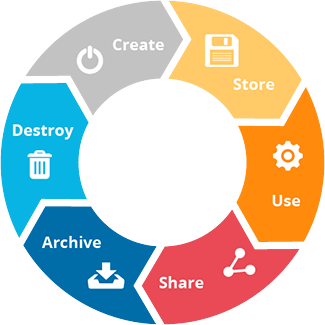
The Data Management Lifecycle
Every piece of manufacturing data moves through the same basic lifecycle, whether the plant acknowledges it or not:
Collection — Is the right data being captured at the source? Are KPIs defined at the attribute level, tied to specific products, operations, and process steps? Or is the plant collecting whatever the historian happens to store, hoping the right signal is in there somewhere?
Storage — Is the data organized in a way that makes it retrievable? Are structures normalized and indexed appropriately? Is there separation between operational data and historical archive, or is everything in one growing database with no partition strategy?
Use — Can engineering and operations teams actually access the data they need, in the form they need it? Or does getting an answer require a SQL query, a call to IT, or a manual export from three different systems?
Share — When data needs to move — to a customer, an auditor, a regulatory body, or an upstream system — is there a defined process for doing that accurately and completely?
Archive — Is there a strategy for moving aging data out of operational systems without losing it? Are archive formats durable and accessible years later, or are they tied to software that may not exist when the record is needed?
Destroy — Is there a retention policy that defines when data can and should be destroyed — and is it actually being enforced? Keeping everything indefinitely is not a strategy; it creates storage cost, compliance risk, and retrieval complexity.
What Factory Data Systems Does
We work with manufacturers to examine the full lifecycle — identifying gaps at each stage, defining KPIs and capture requirements, designing storage and retention architectures, and building the systems that put the policy into practice.
For plants running IntelliTrack™, the data management foundation is already structured — attribute-level records tied to specific products, operations, and events, with a queryable schema that supports both operational access and long-term archival. For plants without that foundation, we help establish it.
The goal is a data environment where records are complete when they're created, accessible when they're needed, and managed with intention from collection through destruction — so that the answer to any production, quality, or compliance question is already somewhere it can be found.
Contact Factory Data Systems to discuss where your data management gaps are and what it would take to close them.
Factory Data Systems has more than two decades of experience in manufacturing data architecture — from plant-floor collection through enterprise integration and long-term records management.